Thursday, November 30, 2006

Endo appointment

Today I had my endo appointment. He thinks that my management is so good that we only need to set up appointments twice a year. I can live with that, as I get the appointments I need with Alice, my fabulous diabetes nurse in the day-hospital unit. In my eyes, Alice is the health care person in my D-team, who knows the most about me and my diabetes when it comes to management of this disease. She has done more trying to get my sugars in control, working with me to reduce the number of morning highs and subsequent severe lows (they were more or less an invariable rule for the last couple of years with Insulatard® [NPH] as basal insulin), assisting in the switches to Lantus and the pump, respectively. That she is the one to turn to when it comes to fine-tuning of insulin and use of the pump in general, was confirmed beyond everything else today.

I started seeing my current endo, when I moved to Odense almost 6 years ago and needed to find a new diabetes team here. My first impression of him was a bit mixed. He is Egyptian, and although he has been living in Denmark for many years, he still speak Danish with quite an accent, so I had to focus on every word he was saying to make sure I understood him right, which also caused me to doubt his medical capabilities a bit. This is not a problem any longer, as I have gotten use to his accent in both Danish and English (he was my co-supervisor during my master’s, and because his research unit is international, the common language in the lab and at meetings was English), and I have gained confidence in his medical capabilities too. Like many other doctors, however, he too has a tendency to focus on the overall results of diabetes care, i.e., the A1c-value. Thus, it took me quite some time to make him realise that a change in my regimen was needed 4 years ago, when I was having large issues with Insulatard® and BG-levels overnight. My A1c was around 6.0, so he couldn’t see any problem.

Sitting in his office today, I almost felt like back then. He asked about, whether I had decided to stick with the pump or not, and I told him that although I am still not convinced, I am being a bit more positive towards it than I was 6 month ago, so I felt I had to give it a bit more time to make it prove its worth. Jimmi and I do want to have kids within the next few years, and as much as I know that the hospital will not approve Lantus for use during pregnancy, I absolutely do not want to go back to Insulatard® and its unpredictability, so, as I told my doc, it will probably be wise to try to make pumping work. I told him about the issues I currently feel I have with it, but he didn’t really have any suggestions as how to solve those. As these issues are specifically related to the sports activities I like to join, he asked if the adhesive on the infusionsites would stay put when I was sweating. I told him that I would usually secure the site with an additional adhesive, because I had experienced unintentional detachment of sites due to sweating. I also mentioned that I had started swimming again, and he immediately asked me how I managed with the pump during swimming.

“I take it off”, I replied

Doc: “So you take out the whole thing?”

Me: “No, I just disconnect like this (showing him how to disconnect the pump), put a couple of pieces of Tegaderm® over the site to seal it, and go swimming”

Doc: “Let me see that again (referring to the disconnection procedure, carefully inspecting the infusionsite). It is so much smarter than those old butterfly-needles that were used with pumps 20 years ago.”

Me: “Yeah, I guess so….” (thinking to myself: Haven’t he kept himself informed about the new advances in diabetes treatment at all for 20 years?!!! He too recommended the pump 4 years ago, when he finally realised that we needed to exclude Insulatard® from my regimen if I was to regain decent control – and now he reveals that he actually knows nothing about pump therapy!!).


I am so happy that I got Alice to turn to in these matters. My endo is apparently helpless when it comes to pump therapy. What surprised me even more today was that he didn’t even wanted to look at my log sheets. Essentially, what he did today was to measure my blood pressure, hand me a lab-sheet for blood work to be done before the next appointment in 6 months, reminding me to schedule an appointment for eye check-up at the same time (the eye exams are done by specialists in the ambulatory too), and then ask me if there was anything else (not specifically related to pump therapy, as he stated that it was probably better to let Alice handle that) that I wanted to discus with him.

I've got an appointment with Alice in two weeks :-)

Friday, November 24, 2006

At long last!

I did it! It has taken me more than a handful of tries, but today I succeeded in completing my swimming session without going low :-) If I had had the time, I would have been able to reach my goal of 30 laps, but one of the ph.d-students of our group was to defend her thesis at 1:15 PM, and if I was to catch some lunch before the talk, I had to stop swimming by 12:30 PM.

I started swimming on Friday noons about a month ago, as we are able to use the university’s swimming facilities for free at these times, and I thought it would be a nice supplement to just biking to and from work and only playing soccer once a week during the winter. I can’t say that I am happy about the time of our free swimming sessions. The choices are Monday-Friday mornings 7:00 - 8:00 AM or Friday 12:00 – 1:00 PM. I am not much of a morning person, least of all during the darkness of winter, and as I have got a 9 km bike ride to get to the university, the morning hours are so out of question for me. The noon time on Fridays is not ideal either, because it is usually during that hour that I will have lunch, but I am stubborn so I wanted to make that work anyway. Until today, however, my swimming sessions (usually 30-35 min, 22-26 laps of 40 m) have always caused me to go low. On the last few lanes my movements are hardly coordinated, my muscles feel heavy, and I have to give in to that stupid low. My approach so far has been to eat a small snack, accompanied by a small bolus, about an hour before going into the water. I used the same approach for soccer practise in the spring where I would also disconnect during the session, so I figured that it would also work for swimming. Apparently it did not though and I have been quite annoyed with that fact.

Today I had a low of 2.9 (52) at 9:15 AM. I treated it with ½ slice of rye bread and didn’t bolus but 0.3 U for it at 10:00. At 11:00 I had another ½ slice of rye bread and some veggies for a pre-swim snack (I have used fruit or müslibars for this beforehand). I bolused 1.3 U for this to cover for some of the carbs as well as the upcoming time off the pump. I tested at 11:45 AM before heading towards the swimming facilities: 10.5 (189). A little higher than I would like before disconnecting for 45-60 min, so I added an additional 1 U.

Due to my limited amount of time today I swam 26 laps in 35 min before having to stop if I was to attend the ph.d-talk. After showering and getting dressed, at 12:45 I tested: 5.9 (106)! When I got back to the office and P asked me how my swimming went today, I couldn’t help raising my arms in sign of victory. “Are you low?”, she asked, and I was happy to announce that for once I wasn’t. I had completed my swimming session in save range. Great! Heidi 1 – diabetes 0 :-) At least for now……;-)

Thursday, November 23, 2006

Chocolate is good for you :-)

Today I got chocolate at work :-) Two bars of dark chocolate, one with nuts and one just plain dark chocolate. Uhmm!!! Did I mention that I love chocolate? ;-) The reason for this chocolate coming my way – and I haven’t eaten it all yet, it will probably last me a few days, if I can restrain myself a bit ;-) – was an expression of gratitude.

I share my office (office may actually be a little too big a word for this 8-10 m2 room) at work with two master students. One of them hasn’t been around for the last couple of months as she is studying for an exam that she needs to pass in January in order to formally be able to finish her master's. The other student, P, is just about to finish her thesis. However, she is pregnant and due to give birth by the end of December, and all of the medical appointments she has to go to (she has Leri-Weill syndrome and Madelung’s deformity (see picture to the left), and during pregnancy her thyroid gland has been getting sloppy, requiring several tests and endocrinological follow-ups, and now medication too), means that she will not be able to hand in her thesis until after the baby is born. We have shared office for years, struggling with our different projects and thesis, and even when I finished my master’s last year and got employed as a research assistant within the group, I kept my desk in this office despite it officially being reserved for students (our group is very space-constrained with only 3 of our 6 principle investigators, as well as our secretary, not sharing their offices. Everybody else shares, usually 4-6 people in each office). P and I have helped each other a lot during the years, both in scientifically oriented issues and in personal issues. She has become quite skilled in spotting if I am heading towards a low, and know how to deal with it if I am not able to myself.

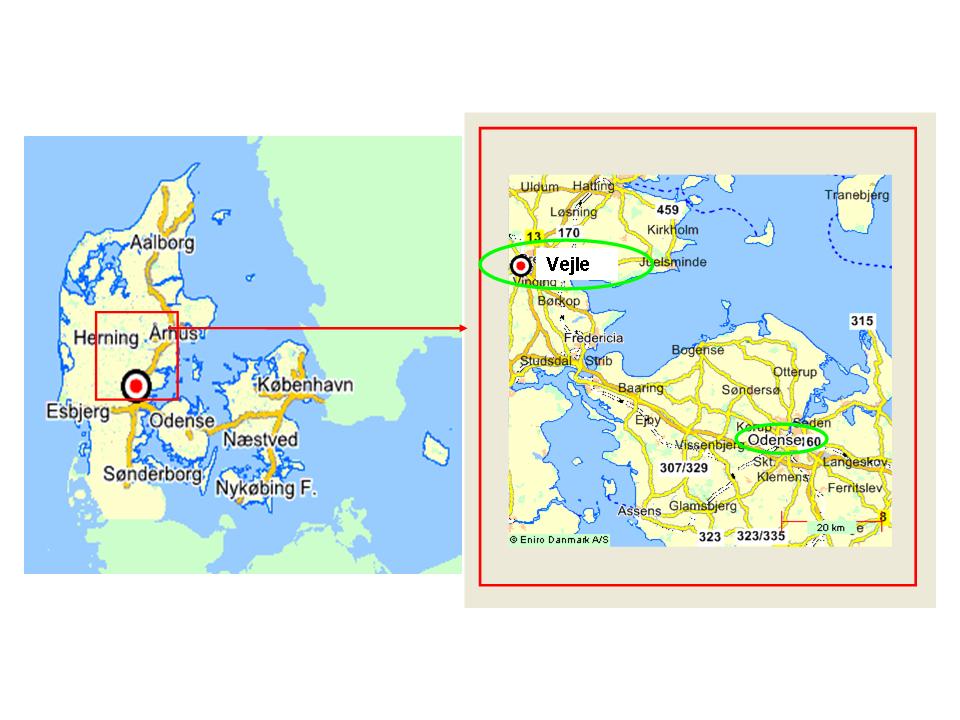
A couple of months ago P and her husband moved to Vejle, where her husband works. This causes P to have a 60-75 min commute to and from the university every day. The medical appointments she has to attend often causes her to take the whole day off because they may be situated in the middle of the day so that she would only be able to spend a couple of hours in the lab before or afterwards. This is of course not practical with this commute, so these days she will often be working at home, reading articles or analyzing spectra. Sometimes, though, these days away will interrupt the experiments that she needs to do in the lab, setting her back more than just the single day that she is actually off. Because of this we have an agreement that she just has to tell me and maybe leave a note on my table, if I am to take care of an experiment for her (e.g. dry down some samples, start or end an enzymatic digest, etc.), so that she can just continue the series of experiments when she is back in the following day. I don’t mind doing this. It usually doesn’t take much time for me, but it saves her at least a day, so I think that it is the least I can do. She is grateful for this, and because she knows that I am a chocolate lower, she usually gets me a piece of chocolate in thanks.

Handing me the chocolate this morning she told me that she just heard on TV last night that dark chocolate may actually be good for diabetics. Two different programs on two different TV channels had sent that message through. Dark chocolate should apparently be able to increase the insulin sensitivity of muscles, thereby assisting in lowering the BG. I have heart many good thinks about chocolate, and dark chocolate in particular, during the last few years, but never anything specifically related to diabetes, so I was a bit surprised though pleased that food research may actually justify my occasional craving for chocolate :-) I entered “diabetes + “dark chocolate”” into Google, and got an amazingly 261,000 hits! I didn’t really find anything new, though, but I did find a couple of sites that stated the link between dark chocolate and the proposed improvement of glucose metabolism although the main effect seems to be lowering of blood pressure and not blood sugar (ooh!). Amy at Diabetes Mine had a post about this about a year ago too where she also points out that the experiments leading to these conclusions were actually done on healthy, non-diabetic individuals with some degree of hypertension. Now I am just wondering why all of a sudden the possible positive effect of dark chocolate has reached the Danish media again more than a year after this research first made headlines (here in Denmark too), and now even focusing more on the effect for diabetes?

Monday, November 20, 2006

Severe diabetes

”You’ve got very severe diabetes, haven’t you?” Ever heard comments like that? I have several times, especially when I have been “stupid” enough to open-heartedly tell people about the challenges of this disease, and what can happen if a low BG is not caught in time. I have never really known what to respond to this type of question. The reasons for this are multiple. Sure, I have had my share of problems with diabetes during the last 12-13 years, but these problems have always come in waves, and not with equal intensity. The first 4 years of my D-life were quite an ease, so things haven’t always been that difficult D-wise. When the issues were most extreme (the last couple of years with Insulatard® (NPH) as the basal insulin), I had several severe hypoglycemic episodes causing several trips to the ER. I had to drastically increase the number of tests done pr day, but as this didn’t eliminate the trips to the ER, I guess it is only natural for third parties to think that I must suffer from severe diabetes. After all, people always seem to know another diabetic who “doesn’t test much, just take the shots, and never has any problems”. I cannot help but think – and thinking back on my trouble-free years too – that when you do not test much, chances are that you don’t notice those highs or lows that ought to have been corrected, e.g. by change in your general insulin regime, thus generally you are a bit on the high side some times and on the low side at others.

I guess it all points down to the eyes that see in the given situations. The reason I am ranting about this today is that I was asked the above mentioned question during the weekend. On Saturday we had our soccer team’s end-of-the-year-/Christmas party, and at some point I got to chat about diabetes with one of my team mates, getting this question (I cannot remember the exact context, but that doesn’t really matter anyway). She is a teacher and one of her students was diagnosed a couple of years ago. A recent change in his medicine had also caused his levels to fluctuate greatly. I told her about some of the difficulties I have had with diabetes, and answered some of her questions about diabetes in general. Having talked for a while, she suddenly said in a serious tone: “It is quite a difficult condition to handle, isn’t it?” Apparently, she had come to realize that with diabetes thing aren’t always plain black and white, and just to follow some “simple” rules to avoid problems is not the way it works. If this was really what happened, then all I can say is: Mission accomplished! :-) It is not always easy to manage diabetes, and the more people are aware of this the better, especially for the sake of the diabetic children who may not be able to “defend” themselves against the verbal attacks and judgments that ignorant people can come up with (I still remember being told: “Ah, you’ve probably been sinning (not religiously meant), haven’t you?” if I had a high reading, and regardless if the reason for that high was that I had had something sweet or not, I would always feel that I was being convicted for not taking proper care of myself).

Anyway, the party was great, and we were still able to perform pretty well in the indoor games that we had to play on Sunday. Most importantly we had a draw with one of our local rivals, 2-2 (the same result as last week, by the way), and a win of 2-0 against the other local rival, the Football Club of Odense (OB). Maybe it was because we had such strong support with us – despite the late night party, a “fan club” of ours of 7 people (team mates and coaches) had taken the 30 min drive to cheer on us :-) I don’t know. I just know that this past weekend seemed far too short, as one of my team mates put it when we were driving back towards Odense in the dark, rainy afternoon yesterday: “I wish tomorrow (i.e., today) would have been Sunday – but then again, I guess we would just have gotten around to do something else tonight that would make us feel just the same by the end of that day too :-)”.

Wednesday, November 15, 2006

A break

I just read Kerri’s post, ”An open letter to my Pancreas”. I need to join the pack of admirers of her writing style and sense of humor :-) Still, as always, she’s got a point, an important one: Things sure would be much easier if Mr. Pancreas would fulfil its job and not just part of it!

At the moment I am trying to figure out how to predict the effect of cycling on my BG. Usually, my cycling to and from work and activities do not pose any large challenges. Sure, the BG will be lowered a bit, but usually no more than 2-3.0 mM (26-54 mg/dl) on ride of 8-12 km, which does not necessarily pose any threat to my well-being. The last couple of days however, it seems like my bike rides, notably those in the afternoons will send my BG into an almost vertical decent.

Yesterday, I tested at 4:15 PM and got a 6.2 (112) reading. This seemed reasonable. I had a slight bolus from a bun that I ate at 3:00 PM, and because I was heading for indoor soccer practise at 5 PM, the basal was reduced to 60 % at 4:00 PM. The trip to the sports facility where we practise is little more than 4 km. I didn’t have a head wind or anything. I was in a hurry, though, because I had been busy at work (needed to finish a presentation I was to do today), so I was a little late. When I arrived the others were ready to start warm up, and I just thought I would quickly change my close and join them. I did feel a bit light headed, but thought it was just the stress of the still unfinished presentation and me being late. It wasn’t. When I tested just before joining the others, I was 1.7 (31)!! Quite a drop in just 45 min I think! I took me an additional 45 min to get back up in safe range to play, which I of course was rather annoyed with. I didn’t go to the sports facility just to sit around and watch the others play and have fun, I wanted to play myself, but couldn’t because of my BG. I only got to play for about 30 min – we stopped early because we were only 7 people and indoor soccer is quite strenuous when you are constantly involved (the others had been playing 3 against 3 while I had tried to get my BG back up, and once I joined we started a rotating substitution where each player would get 5 min break, thus continuously changing the constitution of the teams to allow every one play with as well as against each other). Fortunately, the anticipated rebound of this low wasn’t too bad. I was 12.1 (218) by bed time, not having been higher – at least what I know of ;-)

Today I went to Glostrup (near Copenhagen) to do the presentation that I had finished during the train ride. Everything went well. I felt - and was indeed - low at lunch, 2.2 (40), probably because I had lunch a little later than usual and having had a busy program all morning, without thinking about where the BG might be at. When I got back to work in Odense in the middle of the afternoon, I had a snack, covered by an appropriate small bolus, worked for a couple of hours and then prepared to head home. I did a test before heading home: 8.6 (155) at 4:30 PM, so this should be enough to get me home without any problems. It takes me approximately 30 min to ride home on my bike, today with a little head wind, but not too much. On my way home I noticed that I started yarning. Not because I felt particularly tired, just because I needed to. To me that is a sign of a BG not being where it is supposed to. Usually it is going low, but sometimes high – why does some symptoms have to be ambiguous? Anyway, I got home and because we were due to eat within 30 min, I didn’t got to do a test right away. I just took part in the preparation of our dinner and then tested at 5:45 PM: 2.8 (50). Dropping 5.8 (104) in just 75 min seems a bit drastic, I think, considering that I didn’t have much insulin in the system (last bolus of 0.8 U at 3:00 PM and basal only being 0.3 U/h from 3:00 PM to 6:00 PM). I would just love a break from this!

Sunday, November 12, 2006

Rebound highs

Today we had the first games of the indoor soccer tournament. The first game was at 10:59 AM in a sports hall not too far away from Odense, so we were to depart at 10:00 AM. Because I had a few things I would like to do before taking off towards our meeting point at 9:30 AM, without being too busy, I had set the alarm clock for 8:00 AM.

I didn’t hear the alarm clock. It showed 8:20 AM when I first opened my eyes because Jimmi came into the bedroom to see how I was doing. A morning low :-( I still got around the things that I wanted to do before taking off for soccer, but in addition I got the joy of rebound highs during the rest of the morning. Before the warm up I was 13.6 (245). The pump didn’t think a correction was necessary. I overruled that decision, though, and sent 2 U into the system. When I checked again about 45 minutes and two games later, I was 15.6 (281). Great! The adrenalin from the games combined with the other hormones of a typical rebound swirling around in my body. I took an additional 4 U, because I don’t play too well when I am high either, and we still had 3 games to play. When we had finished our 5 games about an hour later, I was down to 12.4 (223), and it was time for lunch and another aggressive bolus.

Back home a couple of hours later all the insulin finally seemed to take effect, and I had a reading of 3.0 (54), but except from that I have been steady in target since then, enjoying the effect of exercise on the BG-level too.

Next Sunday the second round of indoor games are on. I hope that I will be able to start the day without a low then. There are enough of other challenges for our team this day as we have our team’s end-of-season-/Christmas-party on Saturday night ;-) I am pretty sure that this will cause as least some to suffer a bit from a hangover. Fortunately, we should be 7 people, and as only 4 will be on the field at a time, the ability to make substitutions should be good. We have a few games to revenge ourselves next time as well as repeat the victories we had today :-) The best of our games today, we won 5-1. In all the games I was responsible for guarding our goal, but because of the rules in indoor soccer (each team has to have at least 1 player on the opponents half at all time – unless they are in minority due to a suspension), the goal-keeper usually take part in the attacking play to create a “power play” situation. Therefore, I was on our opponent’s half in the end of this particular game. From the side line I heard one of our substitutes cheering for a goal in the final 10 sec. of the game. I had just passed the ball to one of the others and turned my head to look at the clock, seeing a “4 sec” left of the game. A fraction of a second later I got the ball back again. I made a short, quick move and took a shot towards the goal. The ball hit the net just as the final whistle sounded :-) Our substitutes were thrilled, they told me that they had actually just been joking when they cheered for a final goal 10 sec. before time, because they didn’t really think we would make it. I just told them that I saw no reason to give our opponents any last chances, thus I took the shot as late as possible! It gave us a good laugh, but I guess that we were too high on our performance in this game, because we weren’t quite as focused in the two final games, both of which we lost. We’ll make that up next weekend!

Thursday, November 09, 2006

Power out

Yesterday Jimmi and I were perfectly rested in our sofa, watching soccer on TV – first a cup game between the local heroes, OB (short for Odense Boldklub), and Broendby, and then F.C. Zulu (a soccer team created by the Danish TV station TV2 Zulu, constituting a bunch of guys who have never played soccer, or any other sports for that matter, before being enrolled in this project, where a former top-player has been their coach :-)) and their Spanish equivalents, with the Danish team targeting revenge for our real national team’s loss of a game to Spain at the World Cup back in 1986. Check out some pictures of the Zulu-boys here.

Watching the Zulu-boys play is always amusing, but yesterday the entertainment was abruptly interrupted: At 9:05 PM there was a complete power out in our area! The whole neighborhood was dark, although we didn’t realize that at first. We thought that maybe it was just our own cut-out relay playing tricks with us, but after having groped for a flash light in the dark, we could see this was not the case, so we looked out the window and couldn’t see any lights around our house either. We then had to find some matches and candles – this was actually very cozy :-)

As today apparently is officially D-blog day, you may wonder what this episode has to do with diabetes. Last night, when we were done lighting candles, Jimmi asked: “What do we do now? I want to take a shower and go to bed with a book. Only, I will not have enough light to read by in my bed”. His question made me think about how dependent our daily living and activities are on electrical equipment (TV, computers, powerful light to read and work in, freezers and fridges, etc.). We don’t think much of these facilities until we aren’t able to use them. On the other hand, it is commendable that at least the stuff needed to manage the D on a daily basis (meters, pumps, pens/syringes etc.), if anything, are battery-driven. We do not live in an area where natural calamities may cause power outs and/or other emergency situations very often, thus we have never really thought about having a plan for such situations. We usually have matches and candles (although mostly tea-light candles with a limitted number of burning hours) on stock, but batteries for flash lights and bike lamps are not something we always have in the house, because we primarily use rechargeable batteries for these devices – and once they are flat, they need electricity and a couple of hours to get back to work :-) I don’t even have an emergency kit of supplies and other D-related stuff packed for me to quickly grab if we for some reason or another would have to evacuate our home someday (luckily, I think chances are very slim that this scenario should ever arise). Anyway, I guess I actually ought to have such a kit, regardless.

Power came back on at 9:37 PM yesterday, so it wasn’t that long we were without power. Despite the cozy atmosphere created by the lit candles, I actually appreciated being able to test and treat that bed-time hypoglycemia (2.0 [36]) having sneaked up on me, without having to carry a torch around the kitchen to find the needed snacks in the fridge and cupboards. Although, maybe being a bit inconvenient, a torch-search for food might actually keep one from returning to the cupboards and fridge, over-treating the low? ;-)

Monday, November 06, 2006

".....your result sure embellishes the statistics...."

As I wrote in my last post, I wasn’t sure how my diabetes nurse, Alice, would react to the result of my last HbA1c. I haven’t had time to post about it until now, although my appointment with her was Thursday last week.

The appointment started out with us discussing some things related to the “insulin pump” that the hospital is working together with a company to develop. Alice told me that they had just had another meeting with the company the day before, this time with patients using insulin pens. These patients had, as expected, been far more positive in their evaluation of the product than us pumpers had been. She also had to tell me that the company seemed to have realized that perhaps they ought to work a little bit closer with the caregivers, i.e. the nurses, on some of the dosing issues that had come up during the meetings. One of the representatives had done some calculations the night before the last meeting, and although he couldn’t recall exactly how he reached the results, he was proud to announce that based on his calculations, the typical daily dose of insulin for a type 2 diabetic would be around 15 U! No need to say, the nurses’ reaction to this statement was utter surprise that was not to hide behind a tolerant smile :-) Anyway that is another story; I just think it perfectly illustrates the need for companies working with diabetes remedies to work closely with patients as well as caregivers to obtain the best results.

Proceeding to talk about my management with the pump, we got to HbA1C result. Alice’ reaction to the results just illustrates why you got to love her as a nurse and a person! With a sincere smile upon her face this was her comment to it: “Well, I don’t know how I should reward you, if I ever manage to see a 6.0 on your chart. On the other hand, I must admit that your result sure embellishes the statistics of the A1c of our pumpers!” No hard words, just a smile and this comment along with the “as it is now, I still think we should aim as getting you a bit higher, though”.

I think Alice is the only caregiver I have been seeing through all of my years with the D, who acknowledges the facts that she can say as much as she like, but there is no guarantee that the patients will comply, and that the changes to be made need to be realistic from the patients point of view too. This is also why the conclusion to this appointment was that I would start out cutting 0.05 U of all the basals during the day, so far not touching those in effect during the night, because night time lows do not seem to be an issue. The aim still is to slowly elevate my general BG level just a bit, but at a pace that I am confident with (I do confess not to like seeing numbers above 11.1 (200) in general, many times having a hard time confining my desire to correct it). She understands that, and tries to work with me to find satisfactory solutions. She really is great, and I wish that all of you could be seen by someone like her, when you need to make adjustments that cannot just be made by a few words from the endo in his consultation (no many adjustments can, by the way!).

Tuesday, October 31, 2006

5.3

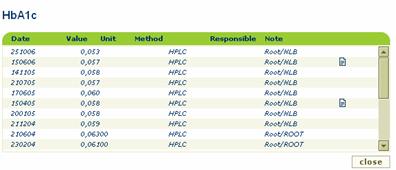
The last HbA1c I had before starting on the pump was 5.8 % (Nov. 14 2005). In April this year, when I started pumping, the aim of my diabetes nurse and I was to try to increase this just a little (to 6.0 %) to see if this would also eliminate some of the nasty lows that had experienced. While these nasty lows were not that numerous after the switch to Lantus 3 years ago, they would occasionally show their ugly face, usually leading to a trip to the ER or a visit from the paramedics in our home, so I sure would like to get rid of those.

As described in previous posts, the switch to the pump still has to prove its worth in relation to lows. Because of that I wasn't too surprised to see a slight decrease in my HbA1c at my endo appointment in the end of June, almost 3 month after pump start. At that time it was 5.7 %, which would be great if it wasn't because of all the lows it included.

Last week I mailed another sample for HbA1c-analysis. Sunday evening I went into my web health portal to see if the result was back yet. It was. I have an appointment with my diabetes nurse this Thursday, and I am looking forward to see her reaction to the result. 5.3 % it said, which is the lowest it has been since I moved to Odense in the beginning of 2001.
My HbA1c results the past 2 years

Before that I had results as low as 5.1 %, which at that time was more a concern to my doctors than to me, because I didn't had that many low, and certainly not as many requiring assistance in their treatments as I have had afterwards, even with higher A1c's.


I will have to admit that the perfectionist inside me most certainly aims for an A1c that is normal, i.e. in non-diabetic range (4.6-6.4 % as far as I remember from patophysiology classes). Not at any costs though. The current 5.3 % result, while in this range, stores too many low lows. I cannot remember ever having tested, or even being able to test, at 1.1 (20) or lower (my meter just reads LO for values of 1.1 and below) in all the years I was on MDI. I have already lost count on the number of times this has happened while on the pump, but it is at least a handful of times. Of course these lows are somehow outweighed by the highs that has also been present, especially after soccer games, but that just shows that the BG-curve has not leveled out as much as anticipated. Hopefully this will happen with time, but it is a bit difficult to be patient, when you were promised results, potentially within 3 months.


It may sound like I am all negative about the pump and the promises that comes with it. That is not the case. I certainly see advantages with this therapy as well. I am probably just, still, a bit frustrated by the fact that I cannot seem to get a hold of things with CSII, and that it regularly causes issues that are not only troublesome but also scaring at times. I hope that my next A1c will be as great as this one, only without the hypoglycemic backside of the result :-)

Sunday, October 29, 2006

Winter is coming

The past night we changed from summer time to winter time. While it is lovely to have your weekend extended by 1h – especially when you have attended a party (soccer season winding-up party) on Saturday night – and I am looking forward to be able to go to work in daylight, at least for a couple of weeks, it is getting darker and colder outside. Winter is coming. The weather forecast for the week to come had sleet in it. Like the roads and bike tracks aren’t slippery enough as they are now with all the wet, fallen leaves lying around!

I don’t know about you, but for me there has always been a good correlation between required insulin doses and season of the year. I tend to need more insulin during the winter months, probably because I am not as active as in summer. I still ride my bike to work every day during the winter, and this year I have also, besides the weekly indoor soccer practise, resumed swimming again, so it is not like I am totally inactive. Still, compared to the summer, where I usually have two soccer practises, 1 game, and extra bike rides “for fun” on the program, winter does not entail as much physical activity. When on MDI I would usually have to increase my Actrapid (Regular) doses by a couple of units with each meal, the Lantus dose in general staying the same.

The past night we changed from summer time to winter time. While it is lovely to have your weekend extended by 1h – especially when you have attended a party (soccer season winding-up party) on Saturday night – and I am looking forward to be able to go to work in daylight, at least for a couple of weeks, it is getting darker and colder outside. Winter is coming. The weather forecast for the week to come had sleet in it. Like the roads and bike tracks aren’t slippery enough as they are now with all the wet, fallen leaves lying around!

I don’t know about you, but for me there has always been a good correlation between required insulin doses and season of the year. I tend to need more insulin during the winter months, probably because I am not as active as in summer. I still ride my bike to work every day during the winter, and this year I have also, besides the weekly indoor soccer practise, resumed swimming again, so it is not like I am totally inactive. Still, compared to the summer, where I usually have two soccer practises, 1 game, and extra bike rides “for fun” on the program, winter does not entail as much physical activity. When on MDI I would usually have to increase my Actrapid (Regular) doses by a couple of units with each meal, the Lantus dose in general staying the same.

Approaching the first winter with the pump, I am looking forward to see, whether the tendencies noticed on MDI do also apply to CSII, or if that is just another set of experiences that I can forget all about in relation to diabetes management. Starting on the pump was like starting from base once again. Of course, some of the experiences that I had build through 16+ years of diabetes would still apply, but the vast majority of them had to be modified.

Resuming swimming has been a challenge. I have about 18 years of swimming experience, 12 of these with diabetes, but the last 3 or 4 years I haven’t really made it to the swimming facilities. This winter I have decided to give it another try, though. I work on the University, and students as well as staff are allowed to use its swimming facilities for free at hours when no teaching takes place there. For the staff, Mon-Fri from 7:00-8:00 AM and Fridays between 12:00 and 1:00 PM are available. The morning hours are a no-go for me. When it is dark outside, I cannot get myself out of bed before absolutely necessary, and as I have a 30 minutes bike ride to reach the University, I would have leave home at 6:30 AM or something like that to take advantage of the morning swimming hours. The hour on Friday noon is not ideal either, but I am working at getting into a routine that allows it. So far (3 attempts) I haven’t had too much success. I thought I could use the same strategy that I used for soccer practise in the spring: I would have a small snack, accompanied by a small bolus (<>r at 12:35). Hmm, another indication that I was low. I did not expect to see the number I did on the meter, though. Sure I felt the weakness you do when you are low, but other than that I didn’t feel too impeded by it. Until I saw the number, that is! 1.6 (29)! Damn, grab glucose tabs and M&M’s in my back and start chewing. Slowly made the 700 m walk back to my office, cursing and wondering whether I should make a stop at the canteen. I decided not to stop at the canteen - my hypoglycaemic brain couldn’t handle that challenge - and headed straight to my office and my lunch box and sugary cola. It took me a good 45 minutes to get back to my normal self. Why does it have to be so difficult to succeed? With 3 failed attempts, I am now considering not to do the extra snack-bolus thing before swimming. My guess is that it may prevent me from going low, but is also likely to leave my above 11 (200) when I finish, and that is really not in my interest either, as by that time I am usually hungry because I will normally have lunch around 12:00-12:30 PM. Maybe this is just another one of the choices between cholera and the plague that diabetes offers you?

Tuesday, October 24, 2006

Up front on diabetes research and development

A couple of weeks ago I got a call from my diabetes nurse. She told me that the hospital had started an innovative collaboration with a private company. The “aim” of this collaboration was to develop a sort of a “single use pump”, a device to be put onto the skin to deliver insulin for 3 days, after which it should be replaced. The company was not really into diabetes and insulin treatment, and thus they would like to discuss the features and possibilities of this device with patients and caretakers. Therefore the company had asked the hospital to arrange for a meeting with a host of diabetics, half being pen-users and half being pumpers. If I was interested, I was invited to participate in this meeting. I thought that sounded interesting, and figured that I would be able to make arrangements in order to leave work a little earlier on the day of the meeting, so I accepted the invitation. “Great, you will receive a letter from H (chief physician on the endocrinology ward of the hospital, and apparently consultant for the company on this project) with more information about the meeting”.

The letter informed us that apart from us as patients, the three diabetes nurses that are involved in pumping and H himself would participate in the meeting. Apparently the company, in collaboration with the hospital, had developed a new insulin pump that would go into clinical trials at the hospital next year. As the company was new on this field, without much experience with insulin treatment, they would like diabetics to advise them about views on pumps in general, as well as evaluate their prototype regarding the idea behind the concept, the design, and other wishes or needs in connection to pump treatment. They would want to present the prototype and get a patient to try it. That sure sounded interesting!

Yesterday was the day for the meeting. This was the first meeting in Odense that the company and hospital would host. We were 8 diabetics on pumps, the three nurses, H – attending another meeting simultaneously, and two representatives from the company. H opened the meeting by welcoming the company representatives and us, describing us as part of the elite of diabetics, people who were on top of their diabetes management (nice to know :-) although I am not sure how much insight he actually has on this, as I don’t think that he is a consulting doctor anymore). By the company representatives request we introduced ourselves to them and each other, on camera because they needed to be able to take our opinion back to their engineers. It turned out I was among people, who had been diabetics for as long as 50 years! A few had lived with this disease for 35+ years, one of them having had a pump for more than 20 years (several different types along the way).

When the representatives presented this new “single use insulin pump” to us, they soon learned that some parts of the concept/design was not ideal. We also had to turn our minds into not seeing this new product as an insulin pump in line with the pumps that we use, but rather sort of an insulin pen based infusion-device. It is an oval-shaped, wireless, plastic device with an electronic part that is reused when the “pump” is replaced. It is filled with insulin from an ordinary insulin pen – a very smart feature in my opinion. On its backside it is covered with an adhesive, and to insert the devise, you attach it to your skin, pres a button to introduce the needle into your skin, and remove said button, so that you are left with only this 7.5 x 5 cm (2.95 x 1.97 inches) and about 0.7 cm (0.3 inches) thick oval shaped devise. 20 minutes after insertion the “pump” will start infusion of insulin at a pre-set basal rate. A button on the devise allows you to administer boluses, each press on the button will release 1 U of insulin. The “pump” will continue working until empty, or about 3 days, at which time it will alarm you by vibrations, sound and light, to make you replace it. As you might have guessed by now, said presentation (of which I have only reported the most essential parts) led to quite a few points of criticism and comments. The devise did not enable you to change the basal rate, nor did it allow administration of “odd” numbers of units for boluses. This of course should be seen in the light of the target group of patients for this devise: Diabetics currently on a pen regimen, who may not yet be fit to take the full step into pumping, or who attends a hospital without the economic potential to pay for a pump (in DK, pumps and pumping supplies are financed by the hospital treating the patient) – this devise is supposedly cheaper than regular pumps although, of course, more expensive than traditional pen-treatment, and otherwise might benefit from a “near-pumping” regimen.

I tried the prototype on, without a needle in it, and it was actually surprisingly comfortable to wear, despite its size. I would like to show you a picture of it, but I will refrain from that as I am not sure whether the company has otherwise gone public with their new concept yet – and I wouldn’t want to give their idea away now, would I :-) We all filled a questionnaire about our own way of treating our D as well as our thoughts about the new devise, its advantages and limitations. The company representatives expressed that they had greatly benefited from the meeting, being a bit surprised about our main point of criticism (the lack of the possibility to change the basal rate as needed), and they would take our response into consideration in the ongoing development of the devise.

H returned to close the meeting by handing us another questionnaire, this one being related to his own project on developing a sensor to alarm diabetics about hypoglycaemia – also an interesting project indeed. The nurses handed out envelopes containing a tube to sample blood for an HbA1C and a question about our quality of life before and after the pump. This is for their continual specification on the regulation of pump users. Thus, this was an afternoon of multiple questionnaires as well as a demonstration that the hospital, and especially H, is up front in research and development when it comes to diabetes :-)

Monday, October 16, 2006

Damn diabetes

I guess the title of this post eloquently expresses what I, along with all other members of the OC, feel about this disease from time to time! My need to express myself in this way now emanates from its interference with my plans and performance this weekend.

I hate when an out-of-range BG-reading requires me to change or postpone my plans! Yesterday we had the final game of the fall season. It was a morning game starting at 10 o’clock (very wet grass and temperatures slowly creeping up from 5 degrees Celsius – something like 41 degrees Fahrenheit – but actually it wasn’t that bad playing in shorts!). My fasting BG at 7:45 AM was a little higher than I like it to be: 9.9 (178). I didn’t correct for that though, as I knew I had a hard game coming up. However, when I tested 1.5 h later, getting ready to go out to the field to start the warm-up, I had dropped to 2.9 (52). I changed the temp basal rate from 60 % to 0 % for 90 minutes, while I chewed down glucose tabs and banana. Out on the field we got the line-up. I was to start as left defender. Certainly not a favorite position for me, but to the long line of injuries, especially among our regular defenders, our coach apparently saw no other option than to place me there. So, I started warming up, not feeling too fit due to the low start, but hoping that it would improve before the game started. It didn’t. My legs felt more and more heavy, my passes were generally off, and 10 minutes before game start I capitulated and found my meter again: 2.4 (43). Not good! There was no way I would be able to get it up to 6.0 (108), where I like to be during soccer, before the game started :-( Our coach changed the line-up and I sat down, exhausted and pissed at the D, finding more glucose tabs, juice and müslibars to elevate the BG, while wondering what the hell had happened to my solid breakfast that should definitely have had time to take its effects before I left the house 5 minutes before our time of meeting prior to the game (it was a home game, being played just across the street where I live, so there are only about 1.3 km [0.8 miles] from my front door the locker room where we meet before games). About a quarter of an hour into the match, after having consumed an additional 40 grams of CHO or so, I was slowly climbing to 3.2 (58). By the end of the first half I could start my warm-up for the second time that morning, so that I could replace one of our wings at the break.

The damn diabetes precluded me from playing a full match of soccer! More than anything, I hate when diabetes prevents me from doing things that I like to do, e.g. play soccer. Also it is frustrating that hypos or hypers occurring before or during a game affects your performance negatively. I ended yesterdays game on a fair 8.0 (144) at 12 o’clock, but I sure didn’t play the best I could. By the way we lost the game 2-1 despite having had our opponents very well matched during most of the game :-( I got myself a strained inner ligament in my left ankle, but because it was only minutes after I had finally made my entrance to the game, I continued playing and the pain went away, but as you may guess it returned once the joint cooled down after the game. Today it is sore, but there has hardly been any swelling, and I can move around although it hurts like hell if I have been sitting too long ;-)

I guess the winter break for soccer has come on an appropriate time point. The current situation for our team is 5 knee injuries, 1 hand injury (soccer induced!) and then at least a handful of “minor” injuries of fibers in thighs, groin issues, inflamed toes and strained ligaments. That is actually a whole team out with injuries - we are a poor crowd! Anyway we don’t start practicing indoor until next week, so my ankle has a couple of weeks to recover – hopefully :-) Hopefully the D will not interfere as much with my performance in the indoor games either!

Friday, October 13, 2006

Reflection

The soccer season is coming to an end. We play the final game this Sunday. If we win, we end third and collect a cash prize to make our ending-party even better :-) Approaching the end of the out door soccer year makes me reflect upon the seasons (spring and fall) as a whole.

I entered a new club in the spring and felt welcome there from the first minute. A couple of team mates from my former club are in this new club too, and that made the transfer a bit easier – at least I only had to learn about 20 new names in stead of 22 ;-) I am proud of the fact that I fairly quickly entered the team for the games, having only missed 4 games or so (of 20) over the two seasons in total, and three of these were due to me having other appointments on game days. Given that we are more than 20 players, occasionally our coach have had to drop players, so being picked for the team on those occasion feels extra good.

This year was also my first of combining CSII management of my diabetes with soccer. Before that I had about 15 years of experience in handling insulin dosing with injections around practise and games. I was comfortable with that, and although it did not always work out quite as would have liked it too, it usually did not cause too many problems. Exchanging Insulatard for Lantus as my basal insulin three years ago didn’t cause any changes around soccer, other than making it a bit easier to manage in some situations. Starting pumping back in April this year, however, is another story! I felt quite helpless not really knowing how to handle things around soccer. This of course was due to lack of experience, but also because I knew the theory behind pumping, the pharmacokinetics of NovoLog that I was now totally dependent upon and needed to learn my response to, and not least the fact that I did not feel like wearing the pump while playing soccer. Practise quickly turned out not to pose any problems, as my theory about giving a small bolus along with a snack about an hour before starting practise worked very nicely, without causing too many lows during practise or highs post practise. Games turned out to be a tough challenge, though. It was, and actually still is, not at all an easy task to make things work without too large fluctuations in BG levels, and I have expressed my frustration about this several times on this blog. In the summer break my diabetes nurse and I agreed that I should try to wear the pump while playing. That prompted finding a way to wear the pump in order to protect it against the hits of close encounters with the field, ball and other players that occurs in the heat of competition, without affecting my free movability. After a few unsuccessful attempts, the sports pack entered the scene and solved the problem in an acceptable way. I must admit, though, that I would still prefer to play without wearing this. Anyway, the next challenge was to find out how to regulate basals around games. This challenge has yet to be solved completely. For the first game of the fall season I was able to wear the Guardian RT sensor, which provided me with very useful information about BG trends during games, and gave me some ideas on how to fit the basals to counteract large fluctuations. Still, theory and actual occurrences are not always the same. I have only had a few successful game days BG-wise in the current season, and it bothers me because even though I may not see the high BG until after the game, being too high or too low surely affects my performance. The issue have mostly been high BG’s, especially towards the end of the game and immediately after. I am annoyed by the fact that I still haven’t been able to figure out how to avoid the spikes towards the end and immediately after games, without having to battle low blood sugars during warm-up and the first part of the games. It is not that I had perfect sugars for games when I was doing MDIs, but the post-game highs never really went above 13.0 (234), whereas with the pump 15-18.0 (270-324) are the typical results. An example of this is from one of the games this fall. I played most of the game, being replaced about 15 minutes before the end of the game. At that time I tested and got a perfect 6.3 (113). Knowing that it was likely to rise, but also wanting to risk going low, I entered a small bolus, 0.8 U (1U will usually drop me 2.7-3.0 mmol/l [49-54 points]). The game ended, we did a short evaluation of it and then headed for the showers and victory beers. Out of the shower, I did a quick test just to be sure I wasn’t too low. About 45 minutes after the perfect 6.3 (113) and 0.8 U bolus, I was at….. 15.7 (283)! Where did that come from? I had not had anything to eat or drink other than lots of water, and the result had me turn down the beer offer outside the locker room, as I did not want to make it even harder to get back into range again.

The series of examples of severe BG changes in relation to soccer while being on the pump is already long. Why is it that I can start out with a 4.7 (85), just a little lower than I would like, thus eating a couple of glucose tabs and a small banana, and then two hours later, after a full warm-up and only 15 minutes break during the 90 minutes game, landing at 16.8 (302)? I just don’t get it!

Anyway, now the indoor soccer season is coming up, and I look forward to that. Not only because I like the technical aspect of indoor soccer, but I also anticipate that it will be somewhat easier to manage BG-levels for this, as the games usually are no more than 7-15 minutes each. Thus, disconnecting for games should not be an issue, and as for practise I may wear the pump or disconnect by the same procedure as I used for outdoor practise back in spring. Time will tell which it will be :-)

Tuesday, October 10, 2006

60 million blogs

Sunday evening, in a news-program on one of the Danish TV-channels, there was a feature on web-blogs and blogging. The feature was about what blogs and blogging is, and how it has become increasingly popular to share thoughts and experiences with the rest of the world on the Internet, regardless you being a big company or a "“small" Mr. or Ms. "“Nobody"”. This is also the case in DK. Said TV-station started web-blogs via their home-page not too long ago, the aim being that people could discus different topics with the different hosts of the station, and it has been a success. The feature ended with interviews with two Americans, one who had quit his job to be a fulltime blogwriter, and another who was just about to quit her job for the same reason. The speaker announced that world wide an anticipated number of 60 million blogs are now available on the Internet! 60 million blogs! I am just glad that I found the host of D-blogs about a year ago. The number of D-blogs that I have bookmarked in my browser since then has increased. I am no longer able to follow them all every day, but in any idle moment I the up-dates :-) I have (and still do) very much enjoyed reading, writing and commenting on D-related struggles of/in an understanding audience. Doctors, relatives, friends, colleagues and others can express understanding, but in reality we all know that they do not have any chance of really understanding what we go through with the D - just as we do not really have a chance to understand how the our D affects our parents, siblings, significant other...…. Therefore it is a relief to blog in a community where members have felt this disease on their own bodies, whether that be as diabetics themselves or as close relatives.


So happy blogging fellow D-bloggers! Together we are strong :-)

Sunday, October 01, 2006

Time to blog

I admit it, I am not good at squeezing in time to up-date my blog every day, or even every second day :-) Thus, again it has been more than 2 weeks since my last post. Not that there hasn’t been something to blog about during these weeks, there has actually been plenty, time and blogging-discipline just haven’t been on my side ;-)

Speaking of discipline, yesterday my soccer team and I had an important game. Our aim this season is to end third. We do not have the potential nor the desire to advance to the national series (Danmarksserien), which the winner of our pool will do and number to have to go into play-off games for. We do think that we have the potential to end third, though, and since this position also means a cash prize, it motivates us even more. Yesterday’s game was against a team that we knew we could defeat (we won 4-1 last time). However, at the moment we have a number of injuries, the last one occurred within this week, among our defenders. Unfortunately, two of our most stable defenders were not able to attend the game due to other appointments that they had agreed upon months ago. Therefore, in reality we had only one defender left for at least 3 positions, so Tuesday’s practice was used to try to figure out who could fill the 2 two other positions of the defence. It was difficult, and we could certainly have used Thursday’s practice as well, but as this was the last practice of the month, it was dedicated to five-a-side with the boys. I was among those tested for a marking player’s position on Tuesday, but I hoped that could avoid that position in the game. Everybody was exited about the line-up when our coach started his tactical presentation prior to the game. And guess what, I was handed one of the marking player’s positions! His reason for handing me this position was my discipline. He told me that in contrast to some of my team mates he was confident that I would fill the position handed, because when he game me directions I would follow them the best I could. I guess that it is true, although I am still far more confident playing forward or wing. Anyway, I played the full match as marking player yesterday and it went okay. Actually, together with our defensive midfielder I was appointed our team’s WOM (woman of the match, we vote about this after each game, and yesterday 7 different players were nominated, so Stine and I won with just 3 votes each). Our coach once again praised my discipline after the game, immediately nick-naming me Andreas Brehme (German defender from the late 80’s and 90’s, German soccer is known to be very disciplined).

Honored about the compliments from my coach, I can’t help thinking about the basis of this discipline capability of mine. Actually, I am quite confident that the most important reason for this comes from me being diabetic. Think about it; everything about diabetes and diabetes management is somewhat build upon discipline. We need to acquire at least some discipline to remember shots, boluses, tests, and to occasionally resist food-related temptations. Though it is a somewhat boring word, discipline can enable us to feel okay most of the time and take part in the activities that our non-D friends indulge in. Apparently this acquired discipline is useful in other aspects of life too, although we may not give it many thoughts :-)

By the way, yesterday’s game was the first one this year that my BG seemed to act okay before, during and after. Starting at 8.5 (153) and ending at 5.8 (104) about half an hour after the final whistle of the game, I was thrilled that for once I didn’t seem to spike uncontrollably just after. I therefore found it appropriate to celebrate – the BG success and the result of the game (2-2 after having been down with 2 at the break) – by having a beer with my team mates before we returned to Odense (it was an away-match). Now, why is it that one is never allowed to celebrate a success without being haunted by it afterwards? The game and the beer kept my BG on the low side the rest of the evening, and this morning too. Damn it, I just had one single beer, something that usually makes me go high rather than low, and I had had plenty of water during the match and ate something before the beer too, why does it have to slap me in the face like that?

I will stop my rantings for now. I may not post that often, but when I do, I write a lot :-)


Thursday, September 14, 2006

To pump or not to pump, that is the question……

…..I am asking myself these days. The post is partly inspired by several conversations that I have had with one of the girls that I share my office at work with over the past 5 months.

When I started on the pump in April, the agreement was that I would give it at least a 3 months try-out, and if I still felt that it wasn’t a kind of diabetes management that suited me, I could go back to MDI and the nurse would keep her mouth shut about the pump for the next year or so (that was her exact saying, although I am not sure if she would be able to keep that promise if I return to MDI ;-)). When I agreed upon that, I had several reasons to finally give in to the pressure of my diabetes nurse for at least giving it a try. First of all she managed to “sell the concept” to Jimmi, who had been on my side regarding pumping until then. Second, I had – and still have – a wish to eliminate the visits of paramedics/my visits to the ER due to severe hypoglycaemic reactions, not only for my own sake but also for Jimmi’s as these episodes are tough on him too. These episodes had probably also affected his attitude towards the offer of a PhD.-position that I got from Denver back in January. I wasn’t sure about whether to go for that offer or not, at least not until I had had the chance to visit the lab in Denver. I hoped that if the promises of the pump (keeping the BG in safe range) would really turn out to be true, I would at least be able to convince Jimmi that we should go to Denver just to take a look at the facilities and the area in general, in order for me to make a fair decision about the job offer. Both still has to happen :-/

Now the initial 3 months are long gone and I am still pumping, but also still debating the advantages and disadvantages of this therapy with myself. Within the initial 3 months I was so close on quitting several times. I felt like I was starting all over again, having to collect experience for the handling of different situation once again, and being frustrated about very low or high BGs. I managed to pull myself together, however, because I was aware of the fact that it would be impossible to give a fair evaluation of the therapy based on less than at least 3 months try-out.

Having tried the pump has changed my conception of it in some areas, but it has also confirmed others. I have no doubt in the fact that an insulin pump is actually the best mimic of a natural pancreas available for the time being. However, I also believe that things can get a lot better. A pump is not optimal in every context of life. Still, it may be the best alternative in others. This is probably also why I am still not convinced about pumping, yet certain that it definitely is the alternative of choice in some situations.

I want to become a scientist. Working as a scientist in the biotech-/biomedical fields means that your working hours are determined by the experiments and other scientific work that you have to do, and that you are likely to go abroad frequently to participate in internal conferences and meetings with collaborators. For a diabetic this offers several challenges in terms of regulation and the need to be flexible. In this regard, no doubt the pump offers most freedom. I got the pump about a month before I was off to a conference in Prague, with limited success D-wise, but as I did not participate in any such conferences while doing MDI, I don’t really have a basis for comparison yet. Regarding the ability to be flexible in order to finish a day’s experiments late in the evening, I have experience with that on MDI, even before Lantus, and that was not easy. Thus, from a “scientific” point of view, I will probably be better of with the pump than with a MDI regimen.

Why am I debating with myself about it then? One of the reasons is leisure time activities. I still find it very annoying to have to wear the pump during soccer. In general, I frequently have moments where I miss not being attached to anything. Although the pump can be disconnected, you still have the infusion site sitting around. Another thing is high readings. Though I do not have that many of them, every time they make me doubt in the function on the pump just as much as in my own actions in the hours before (did I miscalculate the carbs of my last meal, have I done anything different that may cause this, ect.). With injections there are not that many options to consider evaluating a high reading. Of course you can always doubt the absorption and general effect of the insulin, but usually it pins down a wrong assessment of dose size covering your last meal(s). With injections you can visually confirm that the insulin is going into your system by looking at the movement of the plunger move in the pen. With the pump you have no visual of where the insulin is going (I have tried having a leakage somewhere around the place where the tubing enters/connect with the site once, noticing it by an unexplainable high reading and a very wet site patch when I started a correction bolus).

I guess that what it all comes down to me not being totally comfortable with and trusting in the pump yet, despite the fact that I recognise the advantages of it. That is probably why I find it so difficult to evaluate. So far the list of disadvantages with the pump is longer than that of the advantages, but some of the advantages are compelling, so at the moment I guess it is more like a tie that may tip to either side.

Monday, September 04, 2006

More lows

Once again it has been a full week since my last post, and once again due to being busy, not really having time and energy left to sit down at the computer at night.

This last week my soccer team had 3 matches: Monday and Wednesday evening and Sunday afternoon. I played all three matches, only the one on Sunday full time, though.

Monday evening our opponent was the top team of our league, a team that will most likely be promoted to the Denmark’s series (3rd highest national league in women’s soccer in Denmark) by the end of this season. We meet them in the final match of the spring season, loosing that match 2-0, so we were top-motivated to take our revenge – and we did! We won 3-2 after having been behind twice in the match, so it was really a fight. I took part in the warm-up, but only played the second half. Still, the BG stayed in range (at least to my knowledge) as I was 8.0 (144) at the end – much better result than most of the other games I have played while being on the pump :-)

Wednesday’s match was against a lower ranging team, but we still managed to fall behind after only a few minutes play. Despite that we came back strongly and won 4-1! In this match I had a break of 20 minutes or so, and unfortunately had to fight the D a bit more. I started out at 5.1 (92), but during the first part of the first half I didn’t feel that fit, suspecting that the BG might be the culprit. I was replaced 35 minutes into the first half, and when I tested, I had a 3.1 (56) – no wonder my legs felt so heavy! I had reduced the basal to 65 % about an hour before the warm-up (I already run the lowest basal of the day in the hours from 3.30 to 6 PM, so doing a 35 % reduction gave me a basal similar to what I used in the first match – early afternoon – when I wore the Guardian sensor) and had it running like this for 1 h 30 min, but apparently that was not enough this time. I guess the fact that I already had the match of Monday plus all the ordinary exercise of my weekdays in the system may have played a role.

The nights following these two games all meant noctural hypoglycaemia to me. Annoying, but I guess that by time I will finally figure out how to tweak the basals overnight to avoid these lows. The sooner the better as I am not awakened by the lows myself. Jimmi is, or happens to wake up by some other cause, and notice how warm, sweaty and generally unresponsive I am. Thus he has to feed me some glucose tabs until he can wake me up or at least see that I respond to his actions.

The game yesterday was in the afternoon and I had hoped that this would help me avoid noctural hypoglycaemia. I did avoid it during sleep, waking up at 7.1 (128) this morning. Just before going to bed, however, I had a bad low. I was able to treat it myself, although I still wonder how the h… I was able to do that with a reading of “LO” (i.e., a BG below 1.1 (20))! The most scary thing about it was that it sort of came sneaking up on me. I was actually sitting at my computer preparing this post with the plan of posting it before going to bed. I was yarning a bit, but didn’t pay much attention to that as it was almost 10 PM and I had played a hard, full time match of soccer in the afternoon. Jimmi wanted me to check something out on the computer, which I all of a sudden had difficulties doing, and when he looked at me, he told me that he though I was low and I better go test. I was about to anyway, getting prepared for bed, but when I am that low I usually act very slowly. I remember testing at 10 PM, Jimmi standing beside me, immediately putting a piece of banana into my mouth, just to get me started on eating something. He offered me different treats, but I couldn’t really decide upon any of them, so I ended up continuing to eat banana, accompanied by some chocolate and a few crackers. When I finally started to fell a bit normal again, my eyes hit the time display of my old VCR recorder: 10.45! OMG! To me it felt like I had just used 10-15 minutes to eat while logging the result of the day on my BG sheet – I don’t know why the routine of doing something at a certain time of day/context never seems to be put off by the hypoglycaemic mind of mine!

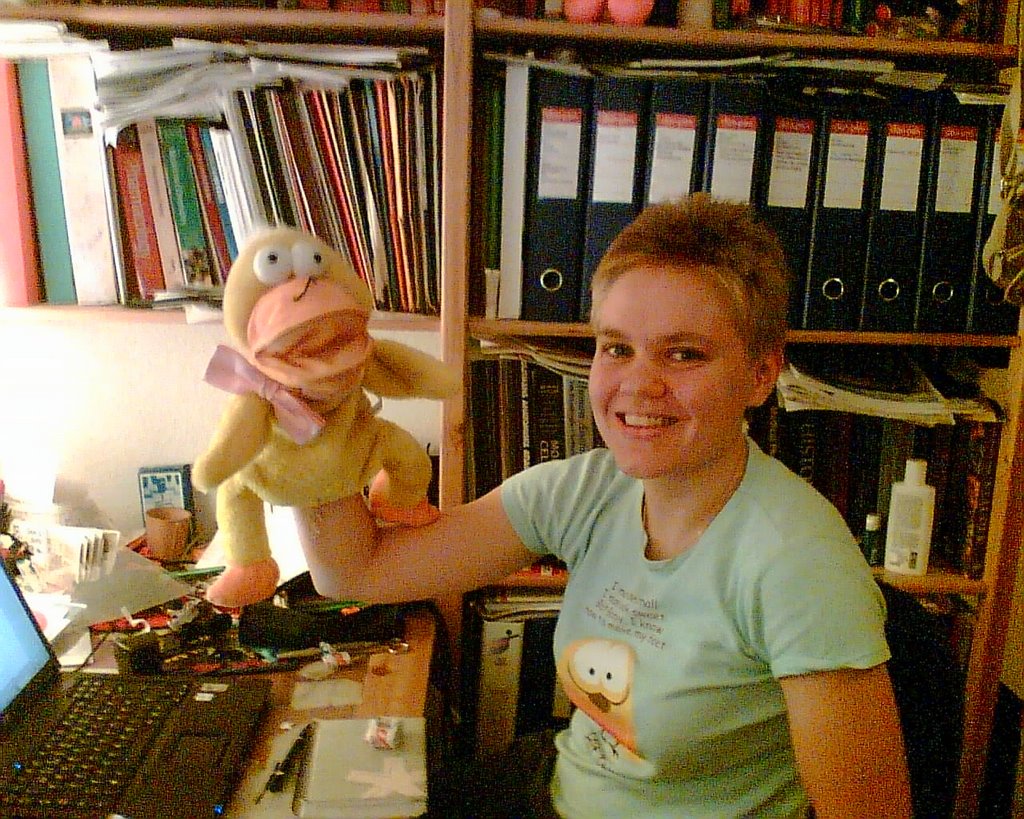
As a side note, we lost Sunday’s game, unfortunately due to a ridiculous mistake by the referee, giving us a 2-1 defeat in stead of the tie that would have been fairer, given the possession of the ball and number of chances to score each team had. There was one happy note about the game for me, however: I played the full match, despite minor troubles with the BG cruising on the low side at the end of the first half/beginning of second half AND was awarded our team’s “Player of the match” title, entitling me to hold our team mascot until the next game :-) I can’t even remember what this hand-doll duck is called, but it is always with us, of course wearing a pink bow tie (because we are the pink army, of course).

Saturday was a bit sad on the other hand. I had to help my younger sister and her boyfriend move from their apartment here in Odense to their new one in Vejle, Jutland ;-( I will miss having her around the city!

That is all for now, folks!